Climate alert. Desert mammals are also at risk, increasingly vulnerable to rising temperatures
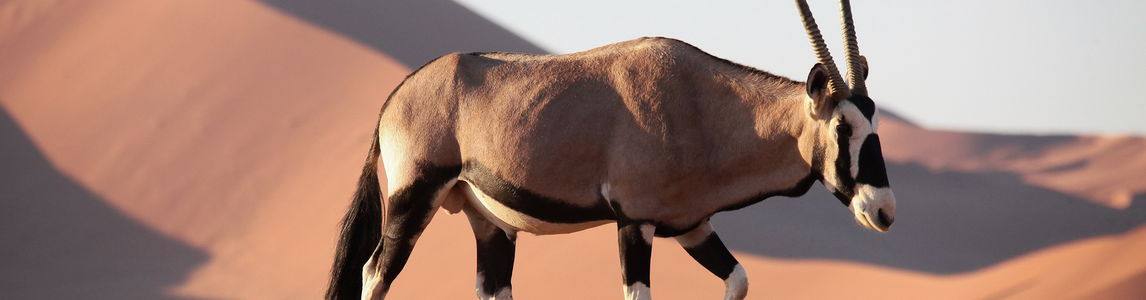
Although the term “desert” is associated with an idea of emptiness or uninhabited land, desert ecosystems are home to an important component of biodiversity, which is not very varied but extremely unique. From animals that are now familiar to most people, such as the desert fox, to symbols of conservation such as the oryx (an African and Middle Eastern antelope), to small rodents: these are just a few examples of the biodiversity that characterises our planet's deserts.
The extreme conditions to which these species are exposed have led over time to the selection of traits that make them perfectly suited to desert life. However, even these specific adaptations may not be enough to cope with the climate crisis.
This was revealed in a study published in the journal Global Ecology and Biogeography, which was conducted by Sapienza University’s researchers on mammals in the Arabian Peninsula.
The results show that the thermal tolerances and adaptations of desert mammals to aridity may prove ineffective against rising temperatures, exposing this unique component of biodiversity to potentially disastrous consequences.
‘For our study,’ says Chiara Serafini of the Charles Darwin Department of Biology and Biotechnology, ‘we chose one of the most arid areas on Earth. It is no coincidence that this is where the world's largest sandy desert, Rub' al-Khali, which means “empty quarter” in Arabic, is located. This allowed us to investigate,‘ continues Serafini, ’the response to climate change of species that currently live at the thermal limits of our planet. ’
Starting from the thermal tolerance of individual species, researchers have found that mammals on the Arabian Peninsula not only live at the thermal limits of our planet, but also challenge the limits imposed by their own physiology.
In other words, the climatic conditions in which these animals historically live are extremely close to their maximum possible tolerance.
However, as temperatures are rising rapidly, the results of this study paint a picture that is nothing short of dramatic: up to 93% of Arabian mammals could potentially lose substantial parts of their historical range within the next few decades.
‘It is essential to recognise that losing these species,’ says Luigi Maiorano, one of the authors of the study, ‘means losing a unique component of biodiversity and with it the secrets of possible adaptations to high temperatures, about which we still know so little. A few centuries of rapid temperature rise,’ concludes Maiorano, ‘could be enough to wipe out adaptations to aridity developed over millennia of evolution.’