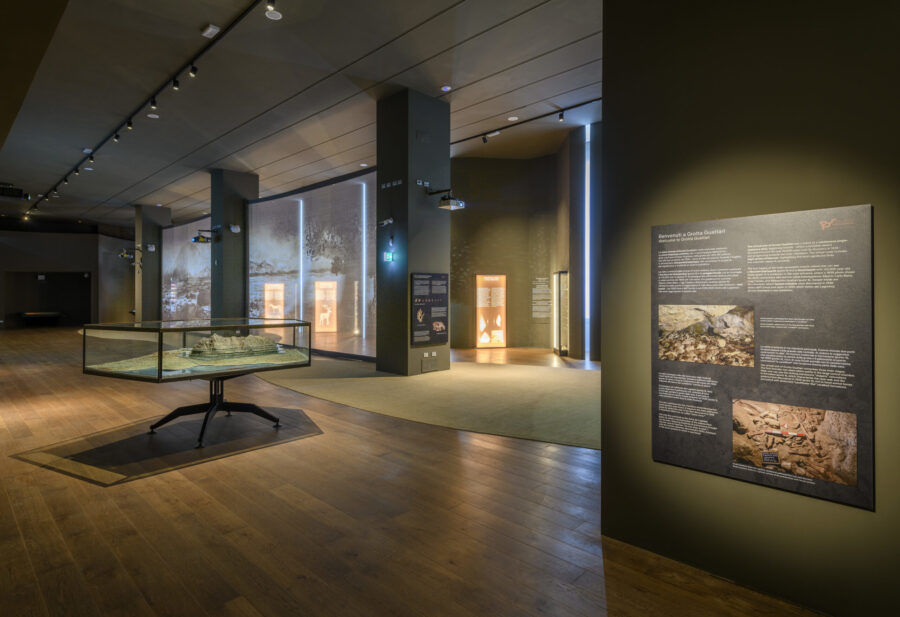
A new exhibition and publication shine the spotlight on the Neanderthals of Guattari Cave on Monte Circeo
Grotta Guattari opens onto the southern side of the Circeo promontory, along the Tyrrhenian coast of southern Lazio. The cave was discovered by chance in February 1939 and the owner of the land, antiquarian Alessandro Guattari, promptly informed the palaeontologist and prehistoric archaeologist Alberto Carlo Blanc.
Towards the back of the cave, in an area that was named the ‘antro dell’uomo’, an almost complete skull and jawbone were found, both of Neanderthal morphology (Guattari 1 and 2). Archaeological investigations were soon undertaken in the cave by the Italian Institute of Human Palaeontology, coordinated by Blanc himself and Luigi Cardini, which brought to light numerous faunal remains and artefacts. In 1950, a second human jawbone (Guattari 3) was also discovered in the sediments of the cave's outer wall. All the human fossil remains were entrusted to the studies of anthropologist Sergio Sergi, who conducted analyses and research that are well known in specialist literature.
Much more recently (2019-2023), the Soprintendenza archeologia belle arti e paesaggio for the Provinces of Frosinone and Latina, in collaboration with the University of Rome Tor Vergata, launched new excavation campaigns at Grotta Guattari directed by Mario Federico Rolfo. The investigations led to the discovery of another 15 human remains, including parts of the skull, postcranial bones and some teeth. This is no small feat: it is the largest Neanderthal sample ever found in a single site in Italy. In addition to human remains, recent excavations have also yielded Palaeolithic artefacts and numerous animal remains, allowing researchers to reconstruct both human presence and the climatic and environmental conditions at the time of the Neanderthals.
The exhibition at the Museo delle Civiltà (MUCIV) has been curated by Maria Grazia Filetici and Andrea Viliani, under the careful and meticulous supervision of a scientific committee composed of authorities from the Ministry of Culture – department head Luigi La Rocca, director general Massimo Osanna, superintendent Alessandro Betori and director Andrea Viliani – officials from the same Ministry (Francesca Alhaique, Antonio Borrani, Francesca Candilio and Alessandra Sperduti) and several well-known specialists from the Universities of Bologna (Stefano Benazzi), Florence (David Caramelli), Rome-Tor Vergata (Mario Federico Rolfo) and Sapienza University of Rome (Giorgio Manzi and Alessia Nava).
This exhibition is one of the few known cases in Italy of a museum dedicated exclusively to the themes of human evolution. The discovery of new human fossils in the Guattari Cave and, more generally, the palaeontological and archaeological evidence collected in the Circeo promontory area have enabled the scientific committee and exhibition designers to offer a comprehensive overview of the extinct species Homo neanderthalensis and the methods used in prehistoric research. The artistic direction has been entrusted to ‘Studio Azzurro’ and the exhibition design to ‘Archedim srl’. In a setting that evokes the colours, darkness and background noises of a karst environment, all the most important fossil finds discovered in Grotta Guattari are on permanent display, including the formidable sample of human remains, in the context of a scenographic, multimedia and interactive presentation of the results of past and ongoing excavations and research.
On this last point, on the very day of the exhibition's inauguration at MUCIV, an initial scientific contribution was published online by the researchers (and their colleagues) who make up the scientific committee formed the previous year for the aforementioned museological purposes. The article, entitled ‘ The new Neanderthal fossil sample from Grotta Guattari, Monte Circeo (Italy): a preliminary synopsis’, was published in the international journal PaleoAnthropology, which is the official publication of both the Paleoanthropology Society (USA) and the European Society for the Study of Human Evolution.
The objective of this initial comprehensive research on the new human fossil sample from Grotta Guattari was explicitly to organise, contextualise and describe, albeit in preliminary form, the entire palaeoanthropological sample, with the primary aim of formally presenting it to the international scientific community, as well as laying the groundwork for future analytical and comparative studies, many of which are already underway, and for the conservation and protection of the site and its extraordinary collection of finds. Including the fossils discovered in 1939 and 1950, the sample currently comprises 22 elements: 11 skull remains, 4 bones from the torso and limbs, and a series of 7 teeth. In some cases, these finds can be traced with certainty to the same individual; therefore, they were named and numbered in order of discovery, from Guattari 1 to Guattari 18. The geological, palaeontological and archaeological data collected during excavation and laboratory work also provide information on the stratigraphy and chronology of the site, which, as a whole, dates back to a period between 121,500 and 65,000 years ago.
The results confirm the exceptional importance of Grotta Guattari. Overall, it should be emphasised that the human fossil sample from this site represents the largest collection of Neanderthal remains ever discovered in Italy. They provide valuable information and promise to improve our understanding of the history of human evolution in Europe and the nature of Neanderthals, their exploitation of the coastal Lazio region, taphonomy and the formation processes of the prehistoric sites of Monte Circeo.
Further Information
Giorgio Manzi: giorgio.manzi@uniroma1.it
Alessia Nava: alessia.nava@uniroma1.it
Francesca Alhaique: francesca.alhaique@cultura.
Alessandra Sperduti: alessandra.sperduti@cultura.
Muciv - Museo delle Civiltà
Laboratorio Neanderthal. Le scoperte di Grotta Guattari
www.museodellecivilta.
References
The New Neanderthal Fossil Sample from Grotta Guattari, Monte Circeo (Italy): A Preliminary Synopsis
https://paleoanthropology.org/ojs/index.php/paleo/libraryFiles/downloadP...
Alessandra Sperduti, Francesca Alhaique, Antonio Borrani, Francesca Candilio, Luca Bondioli, Fabio Di Vincenzo, Angelica Ferracci, Maurizio Gatta, Erica Piccirilli, Stefano Benazzi, David Caramelli, Alessia Nava, Mario Federico Rolfo, and Giorgio Manzi